
Are you wondering whether a digital marketing course is beneficial for finding better jobs, growing your business, or boosting income? In today’s fast-evolving job market, mastering this essential skill has become a career necessity for students, freelancers, working professionals, and every ambitious business owner.
The advantages of digital marketing course training include practical skills, in-demand skills, and strategies that help you become job-ready while advancing your entrepreneurial journey. By understanding digital marketing courses, you can learn online advertising, customer targeting, marketing campaigns, and marketing performance measurement to drive modern business growth. These digital tools help businesses connect with customers, target the right people, make changes instantly, and measure marketing effectiveness across multiple digital platforms.
Consider how YouTube strategically places skippable ads during videos, allowing viewers to skip after five seconds while companies reach a larger audience, boost sales, and increase brand awareness. These real-world examples reveal how digital promotion, websites, social media, Google ads, and emails create career opportunities and support business development. Explore the 10 benefits ahead to discover how digital marketing education, practical experience, and industry knowledge can transform your career trajectory, strengthen customer engagement, and help you thrive in today’s dynamic marketplace.
Things to Consider Before Choosing a Digital Marketing Course
Choosing the right digital marketing course requires checking institute certification, institute reputation, and course quality. A certified institute with a comprehensive curriculum should cover essential modules, including SEO (Search Engine Optimization), SMM (Social Media Marketing), and PPC (Pay Per Click), alongside practical projects, live projects, internships, and hands-on experience.
Before enrolling, learners should compare industry-recognised certifications, recognized qualifications, placement support, job placement assistance, and career support, while checking flexible learning options, online classes, weekend classes, and course accessibility to ensure quality digital marketing education, practical knowledge, professional skills, and better career opportunities.
Top 13 Digital Marketing Course Benefits in 2026
1. Global Reach with Local Precision
Digital marketing removes location barriers, helping a small shop reach global customers while maintaining local roots and serving neighborhood families. Through digital platforms, location-based marketing, targeted marketing, and personalized marketing, businesses can connect with local customers, enter international markets, expand customer reach, strengthen customer relationships, and create growth opportunities without losing their personal touch or local identity.
2. Cost-Effective Marketing Solutions
Digital marketing offers cost-effective marketing solutions, helping small businesses reduce marketing costs through budget control, targeted advertising, and real-time optimization. Unlike traditional marketing, which requires significant investments and may deliver unpredictable returns, Facebook advertising, social media marketing, and online marketing campaigns support audience reach, lead generation, campaign performance tracking, and measurable results.
With effective budget management, marketing optimization, cost reduction, and performance tracking, businesses can improve return on investment (ROI), achieve sales growth, and build business profitability without relying entirely on expensive print advertising, newspaper advertising, or other traditional advertising methods.
3. Real-Time Analytics and Optimization
Digital marketing combines real-time analytics, optimization, and Google Analytics tools to track every click, clicks, conversions, and customer interaction, providing unprecedented insight into campaign performance. Using analytics tools, tracking tools, marketing analytics, digital analytics, data analysis, website analytics, conversion tracking, performance tracking, interaction tracking, and campaign monitoring, professionals can understand customer behavior, user behavior, customer engagement, customer journey, website traffic, traffic analysis, audience insights, campaign data, marketing data, and customer data.
These performance insights, marketing insights, actionable insights, business insights, key performance indicators (KPIs), analytics dashboard, and reporting tools support data-driven decisions, data-driven marketing, marketing strategies, effective strategies, successful strategies, strategy evaluation, campaign effectiveness, performance optimization, real-time optimization, marketing optimization, conversion rate optimization, conversion rates, click-through rates, marketing performance measurement, measurable results, digital campaigns, online marketing, website performance, marketing effectiveness, campaign adjustments, strategy improvement, continuous improvement, marketing decisions, Google Analytics tools, digital performance measurement, campaign analysis, marketing efficiency, and results tracking.
4. Enhanced Customer Targeting
Enhanced customer targeting helps businesses use digital marketing and digital platforms to reach the right people at the optimal time. Through demographics, interests, behaviors, life events, audience segmentation, and data-driven targeting, marketers can understand customer preferences, purchase intent, buying patterns, customer behavior, and user behavior, creating personalized marketing and more relevant messages.
These sophisticated targeting options strengthen targeted marketing, digital advertising, social media advertising, search engine marketing, and PPC advertising, improving customer engagement, lead generation, customer acquisition, campaign effectiveness, and conversion rate optimization while making marketing strategies more precise and measurable.
5. Increased Customer Engagement
Digital marketing encourages two-way communication between brands and customers through social media interactions, email responses, and website engagement, building meaningful relationships beyond traditional marketing.
These digital channels support personalized communication, real-time communication, customer feedback, audience participation, and stronger customer experience, improving customer satisfaction, customer trust, brand loyalty, customer retention, and customer lifetime value while helping businesses strengthen brand credibility, encourage customer advocacy, and achieve sustainable business growth.
6. 24/7 Marketing Automation
24/7 Marketing Automation uses automated systems and marketing automation tools to continuously nurture leads, send personalized emails, and engage customers through around-the-clock marketing without human intervention.
By combining email automation, digital marketing automation, workflow automation, sales automation, and customer relationship management (CRM), businesses strengthen lead management, customer communication, customer retention, marketing efficiency, and business growth through timely communication, automated follow-ups, and improved customer experience.
7. Higher Conversion Rates
Higher Conversion Rates result from digital marketing techniques like retargeting ads, targeted advertising, and optimized user experiences that improve visitor conversion. Through website optimization, landing page optimization, personalized marketing, and clear call to action (CTA) elements, businesses guide website visitors through the customer journey, increasing lead generation, lead conversion, sales conversion, and conversion rate optimization (CRO) while improving customer engagement, marketing effectiveness, campaign performance, and business growth.
8. Measurable ROI and Data-Driven Decisions
Measurable ROI and Data-Driven Decisions help businesses evaluate digital marketing through click tracking, view tracking, and conversion tracking. Using marketing analytics, website analytics, data analysis, campaign performance, key performance indicators (KPIs), and performance metrics, marketers gain clear insights, make informed decisions, improve marketing effectiveness, and measure return on investment (ROI) through data-driven strategies, campaign optimization, and budget optimization.
9. Flexibility and Quick Adaptability
Flexibility and Quick Adaptability enable marketers to adjust digital campaigns using real-time performance data, market analysis, and changing market conditions. Through marketing flexibility, agile marketing, campaign optimization, performance monitoring, and data-driven adjustments, businesses respond to changing trends, customer behavior, audience preferences, and market demands, improving marketing effectiveness, marketing efficiency, and business growth.
10. Enhanced Brand Visibility and Awareness
Enhanced Brand Visibility and Awareness grows through multi-platform presence across search engines, social media, and websites, strengthening a business’s digital footprint. With digital marketing, SEO, social media marketing, content marketing, and website optimization, brands improve online visibility, brand recognition, audience reach, brand reputation, customer engagement, and business growth.
11. Personalized Customer Experiences
Personalized Customer Experiences combine AI, artificial intelligence, and data analytics to deliver customized content, product recommendations, and tailored communication based on individual preferences. Through customer segmentation, predictive analytics, marketing automation, and data-driven personalization, businesses improve customer engagement, customer satisfaction, customer loyalty, customer retention, and conversion rates by aligning personalized marketing with customer behavior and customer needs.
12. Multi-Channel Integration
Multi-Channel Integration connects email, social media, search engines, mobile apps, and websites through multi-channel marketing and channel coordination. With integrated marketing strategy, marketing automation, data integration, and consistent messaging, businesses create unified customer journeys, improve customer engagement, strengthen brand consistency, and support conversion optimization and business growth.
13. Improved Customer Retention
Improved Customer Retention relies on digital tools, email marketing, social engagement, and loyalty programs to build ongoing relationships. Through customer relationship management (CRM), personalized communication, marketing automation, and retention strategies, businesses strengthen customer satisfaction, encourage repeat customers, reduce churn, and improve customer lifetime value.
Digital Marketing vs Traditional Marketing
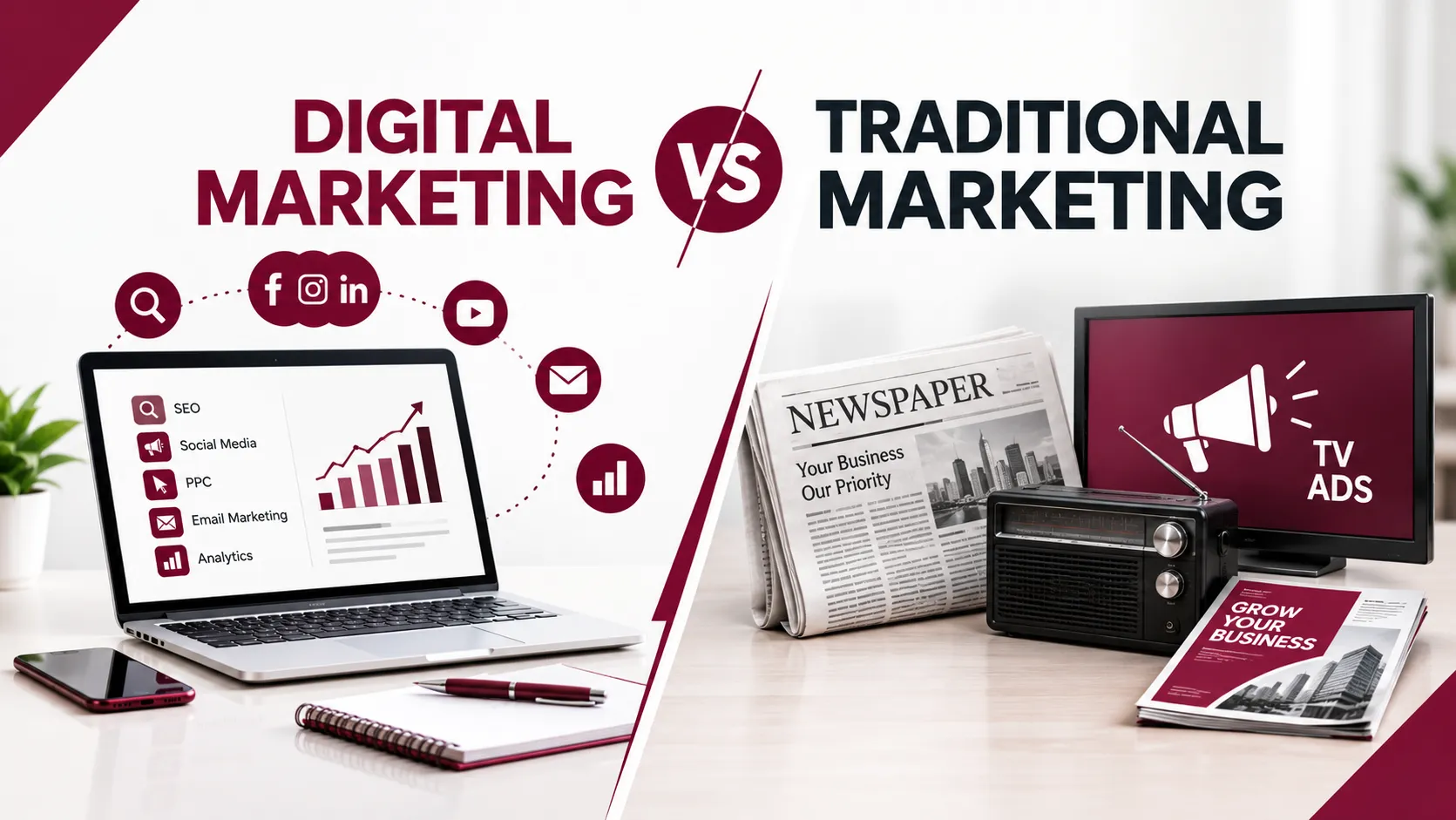
| Aspect | Digital Marketing | Traditional Marketing |
| Reach | Offers global reach and local reach with fewer geographical limitations. | Often has limited reach due to geography and location. |
| Cost | Supports budget-friendly marketing, scalable marketing, and better budget scalability. | May involve high upfront costs and higher marketing costs. |
| Targeting | Enables precise demographic targeting, audience targeting, and customer segmentation. | Usually targets a broad audience or general audience. |
| Measurement | Uses real-time analytics, marketing analytics, and performance measurement to track ROI. | Can involve difficulty tracking ROI and limited campaign tracking. |
| Engagement | Encourages customer engagement, interactive communication, and two-way communication. | Often relies on one-way communication and limited customer interaction. |
| Speed | Allows instant deployment, instant changes, campaign updates, and quick adjustments. | Often involves slow implementation and longer implementation speed. |
| Marketing Channels | Includes online marketing, social media marketing, search engine marketing, and email marketing. | Includes offline marketing, print advertising, television advertising, radio advertising, and newspaper advertising. |
| Optimization | Supports marketing flexibility, real-time optimization, and campaign optimization. | Campaign changes may require more time and additional resources. |
| Results | Provides measurable results, stronger cost-effectiveness, and improved marketing effectiveness. | Results can be harder to measure accurately across campaigns. |
| Business Impact | Helps increase customer reach, brand awareness, and business growth. | Can build brand awareness through established traditional campaigns. |
Why Digiskool is the Right Place to Learn Digital Marketing
- DigiSkool in Lahore connects digital learning with the city’s growing IT sector and startup ecosystem.
- It supports students, professionals, and aspiring digital marketers.
- Digital marketing courses provide practical training, real-time campaigns, and business case studies.
- Internship and placement support help learners gain industry exposure.
- Learners develop digital marketing skills and explore career opportunities in local businesses and leading companies.
4 Key Benefits of Digital Marketing Careers
1. Future-Proof Business Growth
Future-Proof Business Growth depends on digital marketing, digital transformation, and digital innovation as emerging technologies reshape the industry. By adapting marketing strategies to changing consumer choice, consumer preferences, consumer behavior, and changing market trends, businesses strengthen business adaptability, marketing adaptability, competitive advantage, business sustainability, and long-term growth.
2. Personal Growth
Personal Growth begins by enrolling in a digital marketing course, where online courses help learners dedicate time to gaining knowledge. By developing new skills, mastering advanced techniques, and gaining practical knowledge, aspiring digital marketers build confidence, creative thinking, strategic thinking, and adaptability for personal development, professional development, and career advancement.
3. Level Playing Field for All Businesses
Digital marketing creates a level playing field where small businesses can challenge industry giants through creative content, targeted advertising, and a strategic digital presence. With cost-effective marketing, content marketing, digital advertising, and audience targeting, businesses improve brand visibility, customer engagement, lead generation, market access, and business growth while building competitive advantage and supporting business scalability.
4. Great Salary Packages
Great Salary Packages reflect how digital marketing evolves alongside technology advances and new technological developments. Digital marketers who stay up-to-date, develop digital marketing skills, and apply specialised knowledge and professional expertise can improve their earning potential, explore career opportunities, and pursue career advancement across the marketing industry.
Limitations of Digital Marketing
Limitations of Digital Marketing include a rapidly evolving landscape, technical complexity, and the need for continuous learning. Beginners require a diverse skill set to understand new platforms, algorithms, and digital marketing tools, while privacy concerns, ad blockers, increasing competition, and performance pressure can complicate campaign monitoring and consistent results.